

Cinematic nodes
Brief Interpreter, Screenwriter, and Shot List Director — the writing flow for campaign work.
The cinematic nodes are a curated writing pipeline: they take a raw client brief and develop it, step by inspectable step, into a shot list your generation nodes can execute. Each stage outputs text you can read, edit, and re-run — the craft stays visible instead of disappearing into one giant prompt.
Brief → Brief Interpreter → Screenwriter → Shot List Director → (shots)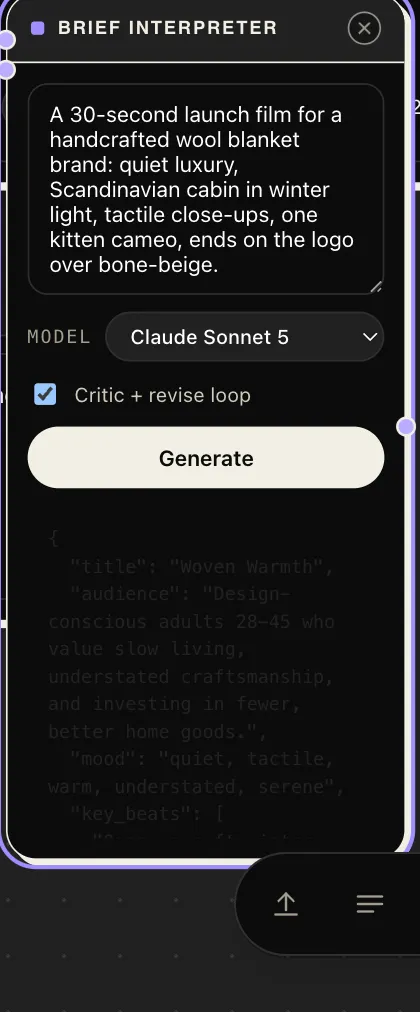
Brief Interpreter
Section titled “Brief Interpreter”Turns a raw brief — pasted email, campaign one-pager, a paragraph of intent — into a structured creative brief: objective, audience, tone, constraints, creative territory.
| Inputs / Outputs | text → text |
| Params | model, brief (fallback when unwired), enable_critique |
Screenwriter
Section titled “Screenwriter”Writes the script from the interpreted brief: scenes, action, voice-over lines — shaped for the campaign’s format and length.
| Inputs / Outputs | text → text |
| Params | model, brief (fallback when unwired), enable_critique |
Shot List Director
Section titled “Shot List Director”Breaks the script into a concrete shot list — one entry per shot with framing, action, and continuity notes — ready to drive Image Gen storyboard frames and Video Gen renders.
| Inputs / Outputs | text → text |
| Params | model |
enable_critique
Section titled “enable_critique”The interpreter and screenwriter can run an internal critique pass — draft, critique, revise — before emitting their result. Slower, noticeably better on ambiguous briefs; leave it off for quick exploration.
Working the chain
Section titled “Working the chain”- Edit between stages. The interpreter’s output is text — correct it before the screenwriter builds on a wrong assumption. Cheaper than regenerating downstream.
- Vary one stage. Re-running only the screenwriter gives you alternative scripts against the same locked brief.
- From shot list to frames, use start/end-frame anchoring on Video Gen with stills generated per shot — that’s how character consistency survives across a sequence.